
Total global greenhouse gas emissions for the month of September 2025 totaled 4.94 billion tonnes COâ‚‚e. For all updates to Climate TRACE country-, state-, city-, sector-, and asset-level data, visit climatetrace.org.
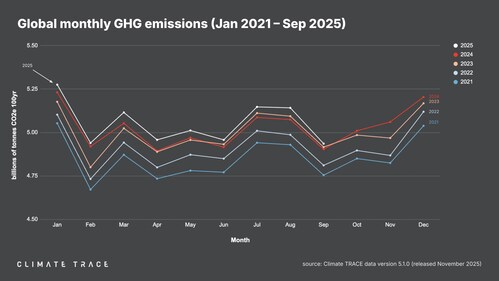
OAKLAND, Calif., Nov. 25, 2025 /PRNewswire-PRWeb/ -- Today, Climate TRACE reported that global greenhouse gas (GHG) emissions for the month of September 2025 totaled 4.94 billion tonnes COâ‚‚e. This represents an increase of 0.66% vs. September 2024. Total global year-to-date emissions are 45.48 billion tonnes COâ‚‚e. This is 0.96% higher than 2024's year-to-date total. Global methane emissions in September 2025 were 34.43 million tonnes CHâ‚„, an increase of 0.54% vs. September 2024.
Data tables summarizing GHG emissions totals by sector, country, and top 100 urban areas for September 2025 are available for download . Climate TRACE monthly data releases now include data on fine particulate matter (PM2.5) emissions, in addition to monthly GHG emissions.
Lookback: Global Greenhouse Gas Emissions Through Q3 2025
Climate TRACE data now cover global emissions through the end of Q3 2025. The sector that saw the greatest increase in emissions as compared to the same time period in 2024 was transportation, for which emissions rose by 3.55% (an increase of 244.47 million tonnes of COâ‚‚e). The United States and China accounted for a third of that increase. Fossil fuel operations emissions also rose, growing by 2.07% as compared to the same period in 2024 (an increase of 149.66 million tonnes of COâ‚‚e), led by increases in Russia, Kazakhstan, China, Saudi Arabia, and Brazil.
Meanwhile, global power sector emissions saw the biggest decline in the first three quarters of 2025 compared to the same time period in 2024, falling by 0.30% (a decrease of 35.68 million tonnes of COâ‚‚e). The decrease was driven almost entirely by declines in China and India, where power emissions were 0.88% lower and 0.91% lower than their totals in the first three quarters of 2024, respectively.
Year-to-date emissions through Q3 2025 show small but positive progress on decarbonization in the Philippines, India, Vietnam, and South Africa:
- emissions decreased 18 million tonnes COâ‚‚e, or 4.58%;
- emissions decreased 10.05 million tonnes COâ‚‚e, or 0.31%;
- emissions decreased 9.57 million tonnes COâ‚‚e, or 4.98%;
- emissions decreased 8.22 million tonnes COâ‚‚e, or 1.85%.
However, some of the world's other major emitting economies, including China, the US, the EU, Russia, Indonesia, and Brazil, saw year-to-date emissions rise in 2025:
- year-to-date emissions increased by 12.24 million tonnes COâ‚‚e, or 0.09% compared to the same period in 2024;
- emissions increased by 71.31 million tonnes COâ‚‚e, or 1.36%;
- emissions increased by 19.01 million tonnes COâ‚‚e, or 0.68%;
- emissions increased by 48.64 million tonnes COâ‚‚e, or 2.09%;
- emissions increased by 81.56 million tonnes COâ‚‚e, or 7.63%;
- emissions increased by 20.23 million tonnes COâ‚‚e, or 2.0%.
Greenhouse Gas Emissions by Country: September 2025
Climate TRACE's preliminary estimate of September 2025 emissions in , the world's top emitting country, is 1.40 billion tonnes COâ‚‚e, an increase of 5.27 million tonnes of COâ‚‚e, or 0.38% vs. September 2024.
Of the other top five emitting countries:
- emissions increased by 6.49 million tonnes COâ‚‚e, or 1.15% year over year;
- emissions increased by 0.88 million tonnes COâ‚‚e, or 0.25% year over year;
- emissions increased by 0.16 million tonnes COâ‚‚e, or 0.06% year over year;
- emissions increased by 8.02 million tonnes COâ‚‚e, or 6.49% year over year.
In the EU, which as a bloc would be the fourth largest source of emissions in September 2025, emissions increased by 0.77 million tonnes COâ‚‚e compared to September 2024, or 0.26%.
Greenhouse Gas Emissions by Sector: September 2025
Greenhouse gas emissions increased in September 2025 vs. September 2024 in transportation and waste, and decreased in agriculture. Waste saw the greatest change in emissions year over year, with emissions increasing by 4.08% as compared to September 2024.
- emissions were 641.20 million tonnes COâ‚‚e, a 0.05% decrease vs. September 2024;
- emissions were 251.77 million tonnes COâ‚‚e, unchanged vs. September 2024;
- emissions were 137.71 million tonnes COâ‚‚e, unchanged vs. September 2024;
- emissions were 796.89 million tonnes COâ‚‚e, unchanged vs. September 2024;
- emissions were 850.53 million tonnes COâ‚‚e, unchanged vs. September 2024;
- emissions were 17.11 million tonnes COâ‚‚e, unchanged vs. September 2024;
- emissions were 1,273.99 million tonnes COâ‚‚e, unchanged vs. September 2024;
- emissions were 787.04 million tonnes COâ‚‚e, a 3.35% increase vs. September 2024;
- emissions were 179.66 million tonnes COâ‚‚e, a 4.08% increase vs. September 2024.
Greenhouse Gas Emissions by City: September 2025
The urban areas with the highest total GHG emissions in September 2025 were ; ; ; ; and .
The urban areas with the greatest increases in absolute emissions in September 2025 as compared to September 2024 were ; ; ; ; and . Those with the largest absolute emissions declines between this September and last September were ; ; ; ; and .
The urban areas with the greatest increases in emissions as a percentage of their total emissions were ; ; ; ; and . Those with the greatest decreases by percentage were ; ; ; ; and .
RELEASE NOTES
Revisions to existing Climate TRACE data are common and expected. They allow us to take the most up-to-date and accurate information into account. As new information becomes available, Climate TRACE will update its emissions totals (potentially including historical estimates) to reflect new data inputs, methodologies, and revisions.
With the addition of September 2025 data, the Climate TRACE database is now updated to version V5.1.0. Note: V5.0.0 and now includes data on potential options for reducing emissions at every asset in the Climate TRACE database.
V5.1.0 includes new modeling of cropland fires, additional sources and updated emissions factors across multiple mining subsectors, updated estimates for solid waste disposal using more detailed input data, updated non-GHG emissions in petrochemical steam cracking, updated SOâ‚‚ and PM2.5 emissions globally, and updated GHG emissions in North America and Europe in the oil and gas transport and production sectors.
A detailed description of data updates is available in our changelog .
To learn more about what is included in our monthly data releases and for frequently asked questions, click . All methodologies for Climate TRACE data estimates are available to view and download . For any further technical questions about data updates, please contact: .
To sign up for monthly updates from Climate TRACE, click .
Emissions data for October 2025 are scheduled for release on December 18, 2025.
About Climate TRACE
The Climate TRACE coalition was formed by a group of AI specialists, data scientists, researchers, and nongovernmental organizations. Current members include Carbon Yield; Carnegie Mellon University's CREATE Lab; CTrees; Duke University's Nicholas Institute for Energy, Environment & Sustainability; Earth Genome; Former Vice President Al Gore; Global Energy Monitor; Global Fishing Watch/emLab; Johns Hopkins University Applied Physics Lab; OceanMind; RMI; TransitionZero; and WattTime. Climate TRACE is also supported by more than 100 other contributing organizations and researchers, including key data and analysis contributors: Arboretica, Michigan State University, Ode Partners, Open Supply Hub, Saint Louis University's Remote Sensing Lab, and University of Malaysia Terengganu. For more information about the coalition and a list of contributors, click .
Media Contact
Fae Jencks and Nikki Arnone, Climate TRACE, 1 (719) 357-8344, [email protected],
SOURCE Climate TRACE

Share this article